Chernobyl person
Voices from ChernobylChernobyl person is a name imposed on people whose lives were divided by the disaster: before it, they were ordinary workers, parents, children, and neighbors; afterward, others treated them as a category apart. The testimonies give that category no single, stable meaning. It can signal forced displacement, radiation exposure, social fear, or a claim to recognition from institutions that sent people into danger and then left them without a language for what they had endured.
From ordinary life to a marked identity
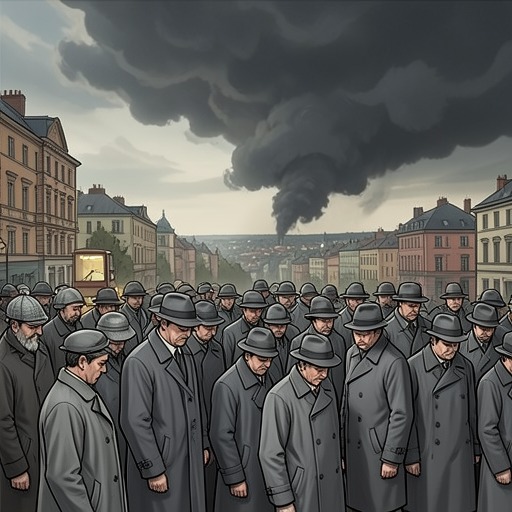
The sharpest definition begins with a contrast between routine and rupture. One evacuee describes a life of going to work and coming home, earning an average salary, and taking an annual vacation. Then, suddenly, that ordinary person becomes a Chernobyl person: someone regarded as an object of public curiosity, associated with an unknown danger, and no longer permitted to blend in. The questions directed at such people concern the fire, fear, and whether they can have children. Even the word Chernobyl becomes a signal that makes others turn and look.
The speaker likens this change to being turned into an animal: visible, scrutinized, and poorly understood. The comparison describes a loss of social standing as much as an experience of exposure. People who want to be treated like everyone else find that the label makes ordinary interaction newly difficult. Its force lies in the gap between the familiarity of the person’s former life and the fearful, speculative identity assigned afterward.
Evacuation deepens that rupture. Residents of Pripyat left on the third day, after the reactor caught fire, and lost not only their town but the lives organized around it. The speaker recalls a friend describing the smell as that of the reactor, while stressing that public accounts turned the disaster into a house of horrors or a cartoon. Against those simplified images, the testimony insists on the limits of what one person can tell: the speaker can offer only what is personally theirs. The expression therefore carries a struggle over who has the authority to describe the affected and what counts as their own truth.
The label in everyday encounters
The identity becomes concrete in small acts of avoidance. After evacuees reached Minsk, they had to pay three times the usual price for train seats. A conductor brought tea to other passengers but asked the newcomers to hand over their cups. They initially misunderstood the gesture as a shortage; its meaning became clear when people learned where they were from and shied away. The label thus worked without formal announcement: origin alone could change how someone was served and approached.
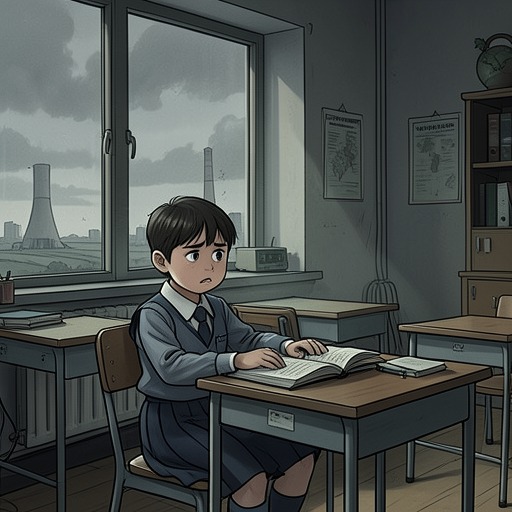
The same suspicion entered displaced families’ homes and children’s lives. One family’s son returned from his first day at school in Mogilev in tears. A classmate did not want to sit beside him because she believed he was radioactive; the fourth-grader, the only child from Chernobyl in the class, was called Shiny. The name made an invisible hazard seem like a visible property of the child, and the testimony describes his childhood as ending early.
Material belongings could also become carriers of this estrangement. When a family returned to its apartment, it retrieved a warm blanket, a coat, and a collection of Chekhov belonging to the mother. A stain on the blanket would not come out through washing or vacuuming; at the dry cleaner, it was found to glow, and the affected piece was cut away. The speaker says the blanket and coat became objects of hatred because they could have killed their owners. The episode shows how displacement followed people into intimate domestic life: familiar possessions could no longer be trusted or used as before.
Love, work, and the costs of belonging
The designation also narrowed the prospects of intimacy. A man returning from the affected area recalls being told by a woman he liked that she would be afraid to have his children because he was now a Chernobylite. In another testimony, a young woman identifies herself with the Chernobyl Hibakusha, survivors whose prospects for marriage and family seem constrained by fear of radiation and inheritance. She is engaged and has already registered the relationship, but her fiancé’s mother asks whether she will be able to have children. The fiancé offers to leave home with her; the question still changes what love can mean. The speaker hears the possibility of childbirth framed as a sin and concludes that loving, too, has become morally burdened.
For a liquidator, the identity could be asserted as a claim to recognition at work. After returning from the army, one man became a second-group invalid at twenty-two. At a factory, his boss demanded that he stop being sick or face reduced hours. He appealed to the director as a Chernobyl person who had saved and protected others; the director replied that the factory had not sent him there. The exchange exposes the gap between the sacrifice invoked by the worker and the institution’s refusal to accept responsibility for it.
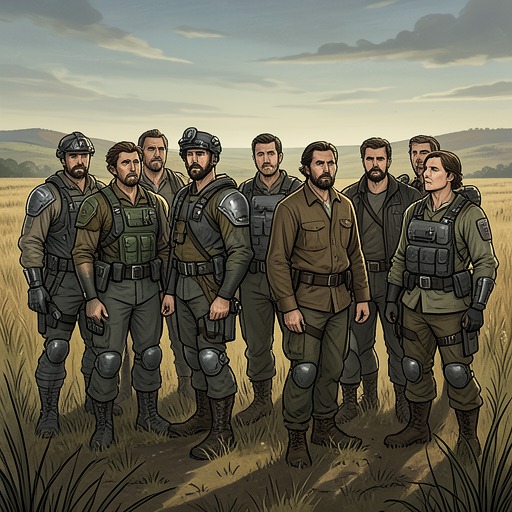
The same man describes how official silence compounded that refusal. He had signed a nondisclosure form and did not speak about what he had done. His unit carried buckets of graphite from the reactor, shoveling it with ordinary shovels; he reports a dose of ten thousand roentgen and says masks, called muzzles, were changed as many as thirty times in a shift. They poured the sarcophagus over the ruins where Valery Khodemchuk had been trapped in the first minutes after the explosion. The speaker calls it a giant grave for one person and a twentieth-century pyramid. After the unit returned, its members were not even given changes of clothes; they wore the same pants and boots they had worn at the reactor until demobilization.
Silence, separation, and contested heroism
The label marks a community, but it does not make that community easy to recognize or reach. The returning liquidator says that at night his mother asked why he lay awake with the light on and said nothing. He could not answer because no one could speak to him in a way he could respond to, in his own language: no one understood where he had come back from, and he could not tell them. He describes the group as lonely and foreign where they now lived, even buried separately from other people, as if they were aliens. For him, comparison with Afghanistan made death there seem more comprehensible, because it had been normal within that war. Here, the identity of survivor or worker did not restore ordinary belonging.
A soldier assigned to prevent former residents from returning to evacuated villages encountered another contradiction built into the post-disaster order. His unit established roadblocks and observation posts, while farmers were kept from their homes, belongings, and crops. Yet on the other side of the road, cows grazed, harvesters worked, and grain was shipped. Soldiers watched women pour freshly milked milk onto the ground and bury eggs; potatoes raised by farmers also had to be buried. The landscape remained beautiful, making the destruction harder to comprehend. The soldier’s uniform and orders placed him between the state’s controls and the people crying for access to their own land.
That soldier recalls wanting to be a hero, an expectation reinforced by political speeches and media coverage. His pay rose from 400 rubles to 1,000, and he resented later accusations that returning workers had profited through higher salaries and early access to cars and furniture. Heroism was therefore both a public script and a contested personal experience: the pay mattered, but, he says, it did not explain why people felt they were doing heroic work. Another account records volunteers diving repeatedly to open a safety-valve bolt when a possible explosion threatened a much wider region. The men received 7,000 rubles, while promised cars and apartments were forgotten; the testimony stresses that those promises were not why they went. The Chernobyl person could be cast as a willing sacrifice even as the survivor’s later needs, injuries, and isolation went unmet.
A name without an easy return
The expression gathers experiences that official records and public curiosity do not resolve. One liquidator says he was warned, in the interests of the state, not to tell people what he had seen. He adds that, apart from those who went there, no one knows what happened, though they themselves did not understand everything. The identity thus joins witnessing to enforced silence: people were present, saw the destruction, and were then discouraged from making their knowledge public.
Other testimonies show that being named did not necessarily offer solidarity. A cameraman is pressured to return to the affected area after already going once; his prior exposure is treated as a reason he can be sent again, while management invokes a future salary review and raise. He privately wishes for five or six children, a desire that makes the casual reassignment especially stark. Across these accounts, Chernobyl person names neither a single biography nor a uniform response. It names the lasting social boundary created when a disaster made people visible as hazards, useful as workers, or compelling as witnesses, while leaving them to negotiate the consequences in schools, relationships, workplaces, and silence.